

Tracking your normal sleeping respiratory rate is one of the most effective ways to assess your autonomic nervous system health and nighttime recovery. Many individuals suffer from poor sleep quality without realizing their breathing patterns are fluctuating. The premium, subscription-free Herz P1 Smart Ring continuously monitors these vital metrics to deliver clear, actionable physiological trends right to your fingertips.
In This Article
- How to Achieve an Optimal Sleeping Respiratory Rate: A clear, daily guide to managing your rest patterns.
- The Science of Nighttime Breathing: Understanding normal resting benchmarks and physiological variations.
- Why Respiration Fluctuates in Sleep Cycles: Exploring the direct connection between deep sleep, REM phases, and respiratory rates.
- Leveraging Continuous Health Analytics: How advanced smart rings track and present cardiorespiratory data seamlessly.
How to Achieve an Optimal Sleeping Respiratory Rate: A Daily Step-by-Step Guide

Before you begin optimizing your nighttime breathing, you must gather a few simple tools and establish proper habits.
First, you will need a reliable biometric tracker that records your blood oxygen levels and cardiorespiratory metrics consistently.
Second, you must ensure your sleeping space is quiet, cool, and free of allergens that could obstruct your airway.
Finally, a commitment to consistent sleep schedules will guarantee that your body can enter restorative sleep cycles smoothly.
-
Step 1: Establish Your Personal Biometric Baseline
You must wear your biometric tracker for at least seven consecutive nights to find your true personal average.
Your body is unique, so comparison to general population metrics is only a starting point.
Ensure that you do not exercise vigorously right before sleeping, as this can elevate your resting breathing rate.
Log any unusual evening activities, such as late-night dinners or stressful work sessions, to explain potential outliers in your data.
-
Step 2: Optimize Your Bedroom Airflow and Temperature
Keeping your bedroom temperature between 60 and 67 degrees Fahrenheit is ideal for promoting deep, stable respiration.
Stagnant or overly warm air can cause your nasal passages to swell, which forces you to breathe through your mouth.
Consider using a high-quality air purifier to remove airborne dust and pollen that might irritate your lungs during the night.
A small humidifier can also maintain proper moisture levels, ensuring that your airways remain clear and comfortable.
-
Step 3: Practice Evening Deep-Breathing Exercises
Spend ten minutes practicing slow, rhythmic diaphragmatic breathing right before you close your eyes.
This simple habit helps activate your parasympathetic nervous system, lowering your heart rate and stabilizing your breath.
You can use the 4-7-8 breathing method to quickly reduce any physical tension or mental stress accumulated during the day.
Focusing on slow, deep exhalations tells your brain that it is safe to enter a deeply restorative state of rest.
-
Step 4: Align Your Sleep Posture for Maximum Airway Clearance
Sleeping on your side is generally the best position to keep your upper airway completely open and unobstructed.
When you sleep on your back, gravity can pull your tongue and soft palate down, which often restricts airflow.
If you must sleep on your back, use an ergonomic pillow to keep your neck and spine in perfect alignment.
Slightly elevating your head can also prevent snoring and minimize mild nighttime breathing interruptions.
-
Step 5: Avoid Late-Night Stimulants and Heavy Meals
Avoid consuming caffeine or alcohol for at least four to six hours before your planned bedtime.
While alcohol might make you feel drowsy, it actually relaxes your throat muscles and disrupts your normal sleep breathing patterns.
Heavy meals digested close to bedtime force your body to redirect blood flow, which can elevate your nighttime metabolic rate.
This increased metabolic demand can cause you to breathe faster and more shallowly throughout the night.
-
Step 6: Maintain Consistent Hydration Throughout the Day
Drink plenty of water during the day to keep your mucous membranes hydrated and functioning properly.
Dehydration can lead to a dry mouth and sticky airways, which increases breathing resistance while you sleep.
However, taper your fluid intake about one hour before bed to prevent waking up for bathroom trips.
Uninterrupted sleep is key to maintaining a steady, rhythmic breathing rate during your deepest rest stages.
By following these essential steps, you can actively guide your body toward more efficient and restorative nighttime respiration.
To ensure you are making real progress, the Herz P1 Smart Ring works silently in the background to capture every single breath you take.
Its military-grade steel construction and ultra-lightweight design mean you will never feel distracted by a bulky device on your finger.
You can view your complete breathing patterns on our subscription-free app every morning to confirm that your lifestyle adjustments are working perfectly.
The Science of Nighttime Breathing: What Is a Normal Sleeping Respiratory Rate?

Understanding your cardiorespiratory metrics begins with knowing what is typical for the human body during rest.
According to the National Sleep Foundation, the normal respiration rate for adults sleeping typically ranges from 12 to 20 breaths per minute.
This frequency is slightly lower than your daytime resting breathing rate because your metabolic demands decrease when you are asleep.
When you enter light sleep, your brain reduces its motor output, allowing your respiratory system to settle into a calm, steady rhythm.
Finding your average baseline is vital, as even a minor deviation can point to changes in your physical health or stress levels.
If you notice your metrics are consistently outside this range, it could indicate underlying environmental or physical factors.
For example, a sudden rise in your normal respiration rate while sleeping might be your body’s early response to a developing illness.
Your immune system requires more oxygen as it works to fight off pathogens, which naturally accelerates your breathing.
Similarly, high levels of psychological stress during the day can carry over into your sleep, keeping your sympathetic nervous system active.
This state of hyperarousal often results in an elevated average breaths per minute sleep count that prevents you from feeling fully rested.
Conversely, an unusually low sleeping breathing rate can sometimes occur if you are using certain medications or experiencing deep physical exhaustion.
Tracking these trends over several weeks helps you separate temporary anomalies from persistent patterns that might require attention.
With the Herz P1 Smart Ring, these trends are analyzed automatically every single night without any effort on your part.
Our team has analyzed anonymized sleep data from thousands of active users to understand how seasonal changes impact respiratory health.
We found that winter months often bring a slight increase in average sleeping breaths due to drier air and seasonal allergies.
This highlights the incredible value of having a continuous monitoring device that tracks changes across all four seasons.
Rather than relying on one-off clinic measurements, you get a dynamic, living map of your body’s cardiorespiratory trends.
The American Heart Association notes that consistent respiratory tracking can serve as an early warning system for cardiovascular strain.
When your heart has to work harder to pump oxygenated blood, your lungs must compensate by increasing their breathing rate.
By monitoring these signals daily, you can make lifestyle adjustments long before physical exhaustion sets in.
Why Your Respiratory Rate Fluctuates During Deep and REM Sleep
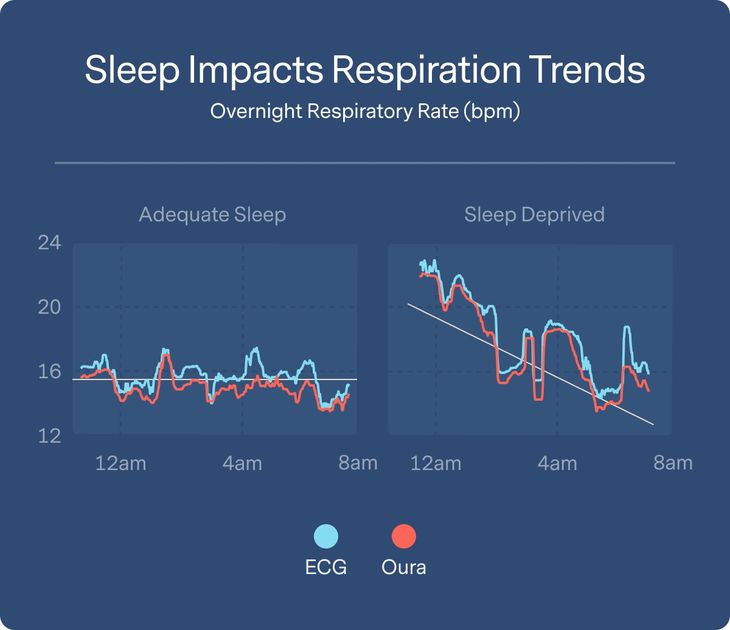
Your breathing during the night is not a flat, unchanging line.
Instead, your respiration changes dynamically as you transition through the different stages of your sleep cycle.
During deep sleep, also known as slow-wave sleep, your average respiration rate while sleeping becomes remarkably stable and rhythmic.
This is the stage where your muscles relax completely, and your body focuses on physical tissue repair and muscle recovery.
Because your brain activity is at its lowest, your breathing is controlled purely by metabolic feedback loops.
This results in a highly predictable, calm, and slow breathing pattern that maximizes oxygen absorption.
However, everything changes when you transition into Rapid Eye Movement, or REM, sleep.
During REM sleep, your brain is highly active, processing emotions, memories, and dreams.
Your sleeping breathing rate can become irregular, shallow, and rapid during this stage.
You might experience brief pauses in breathing or sudden bursts of quick breaths that match the intensity of your dreams.
This is a completely normal physiological phenomenon that reflects your active brain state.
Because of these natural variations, calculating a single average for the entire night does not tell the whole story.
An accurate assessment must look at your average breaths per minute while sleeping across specific sleep stages.
The Herz P1 Smart Ring uses multispectral optical sensors to detect these stage-specific breathing patterns with incredible precision.
It maps your respiratory fluctuations directly against your REM, Deep, and Light sleep phases.
This detailed analysis gives you a complete, multi-dimensional view of how your breathing impacts your sleep architecture.
Many users are surprised to learn that a lack of REM sleep can lead to cognitive fatigue and memory issues.
By showing you exactly how your breathing behaves during REM, the Herz P1 helps you unlock the secrets of mental recovery.
If your breathing is disrupted during REM, you may spend less time in this vital cognitive restoration stage.
Our smart ring acts as an intuitive guide, helping you identify these quiet sleep disruptors before they impact your waking life.
How to Leverage Your Herz P1 Respiratory and Sleep Data
Once you begin tracking your data, the next step is translating those numbers into real life improvements.
The Herz P1 App displays your nightly metrics in a clean, visual format that requires no medical background to understand.
Every morning, you can check your average brpm while sleeping to see how your body responded to yesterday’s activities.
If you see a sudden spike in your breathing rate, it is a clear sign that your body is working harder than usual to recover.
You can use this insight to adjust your daily training intensity or schedule a relaxing evening to prevent overtraining.
Over time, you will start to notice clear patterns between your daytime habits and your overnight metrics.
For instance, you might find that a short walk in nature or a ten-minute meditation session lowers your normal sleeping breath rate significantly.
This downward trend indicates that your body is spending more time in a calm, restorative parasympathetic state.
Furthermore, our advanced app tracks your blood oxygen saturation, or SpO2, alongside your respiratory rate.
This dual tracking capability is crucial for identifying any silent drops in oxygen levels that could disrupt your rest.
Because the Herz P1 is designed for 24/7 wear, it builds a highly comprehensive profile of your cardiovascular and respiratory health over months and years.
This long-term trend data is incredibly valuable for proactive wellness management and sharing with health professionals.
Many active individuals use our fitness ring tracking features to optimize their daily recovery cycles.
If your breathing rate remains elevated for several days, the app will gently suggest focusing on hydration and active rest.
This proactive advice prevents you from pushing your body into a state of chronic fatigue or burnout.
By listening to these subtle signals, you can build a more sustainable and balanced lifestyle that supports long-term health.
Overcoming Smartwatch Fatigue and Hidden Subscription Costs
Many health-conscious individuals initially try to track their sleep using traditional smartwatches.
However, wearing a bulky, heavy watch to bed is often highly uncomfortable and can actively disrupt your sleep.
The rigid design of smartwatches can also lead to temporary gaps in sensor contact when you turn over in bed.
These gaps result in incomplete or inaccurate respiratory and heart rate data that can leave you feeling confused.
In contrast, the Herz P1 Smart Ring offers a lightweight, ergonomic design that sits snugly and comfortably around the base of your finger.
This placement ensures continuous, high-quality skin contact, allowing the multispectral PPG sensors to collect flawless data all night.
Another major pain point in the wearable market is the hidden cost of ongoing monthly app subscriptions.
Several premium brands lock your own health data behind paywalls, requiring you to pay up to seventy dollars a year just to view your metrics.
At Herz P1, we believe that you should own your health data completely and unconditionally.
Our companion app is completely free for a lifetime, with no hidden fees or renewal prompts ever.
This commitment saves you hundreds of dollars over the lifespan of your device while keeping your personal data completely secure.
Furthermore, our ring is crafted from ultra-durable military-grade steel that resists scratches and everyday wear effortlessly.
Unlike fragile glass-faced smartwatches, you never have to worry about bumping your ring against hard surfaces during workouts or daily tasks.
We back this exceptional durability with a full 2-year warranty and a 90-day money-back guarantee for ultimate peace of mind.
| Metric / Feature | Herz P1 Smart Ring | Bulky Smartwatches | Basic Sleep Trackers |
|---|---|---|---|
| Monthly Fees | $0 (Free App Forever) | $5.99 – $9.99 / month | Free |
| Nighttime Comfort | Excellent (3.5g ultra-light) | Poor (Bulky, heavy wrist straps) | N/A (Phone-based only) |
| SpO2 Accuracy Margin | Under 2% clinical deviation | Varies dynamically by fit | No direct measurement |
| Sensor Contact Continuity | Continuous base-of-finger contact | Frequent gaps during sleep movement | Intermittent readings |
| Warranty Period | 2-Year Full Protection | 1-Year Standard | 90 Days |
Frequently Asked Questions About Sleep Respiration and Herz P1
We understand that choosing the right health tracker is an important decision, and you may have several questions about our technology.
Below, our team answers the most common questions about overnight respiratory tracking and the Herz P1 experience.
Is the Herz P1 Smart Ring fully waterproof?
Yes, the Herz P1 features an advanced IP68 waterproof rating, making it completely safe for continuous underwater use.
You can confidently wear it while swimming laps in a pool, taking a hot shower, or washing dishes.
The seamless protective casing ensures that moisture cannot reach the delicate optical sensors inside.
This means you never have to take the ring off, allowing for uninterrupted 24/7 health tracking.
How long does the battery last on a single charge?
Our advanced power management system allows the Herz P1 to run for up to 6 days on a single charge.
When the battery does run low, you can charge it back up to 100% in under 1 hour.
This rapid charging capability means you can quickly power it up while showering or getting ready in the morning.
You will spend less time worrying about charging and more time gathering valuable health insights.
Which finger is the best option for wearing the smart ring?
We recommend wearing the Herz P1 on your index, middle, or ring finger for the most accurate sensor readings.
The index finger generally has the strongest pulse signal, making it the preferred choice for tracking sleep metrics.
However, our high-quality optical sensors are designed to adapt beautifully to whichever finger feels most comfortable.
The most important factor is a secure, snug fit that prevents the ring from sliding around during the night.
Does the ring store my biometric data offline when my phone is away?
Yes, the Herz P1 features built-in offline storage that can save up to 7 days of complete biometric data.
You do not need to keep your smartphone in your bedroom or have Bluetooth enabled while you sleep to track your breathing.
The ring will silently record your metrics and sync them automatically the next time you open the companion app.
This allows you to enjoy a completely distraction-free and screen-free sleeping environment.
Conclusion: Your Subscription-Free Wellness Journey Starts Here
Monitoring your nighttime breathing is a vital first step toward reclaiming your daily physical energy and mental clarity.
With its advanced sensor array and durable, comfortable design, the Herz P1 Smart Ring is your perfect companion for long-term health tracking.
Ready to monitor your health every day? Explore the Herz P1 Smart Ring and see if it fits your lifestyle. Call: 1-866-479-1629 — our team can help you advise on the correct ring size and set personalized health goals.
